AI Game Development Checklist: 10 Gates Before You Build

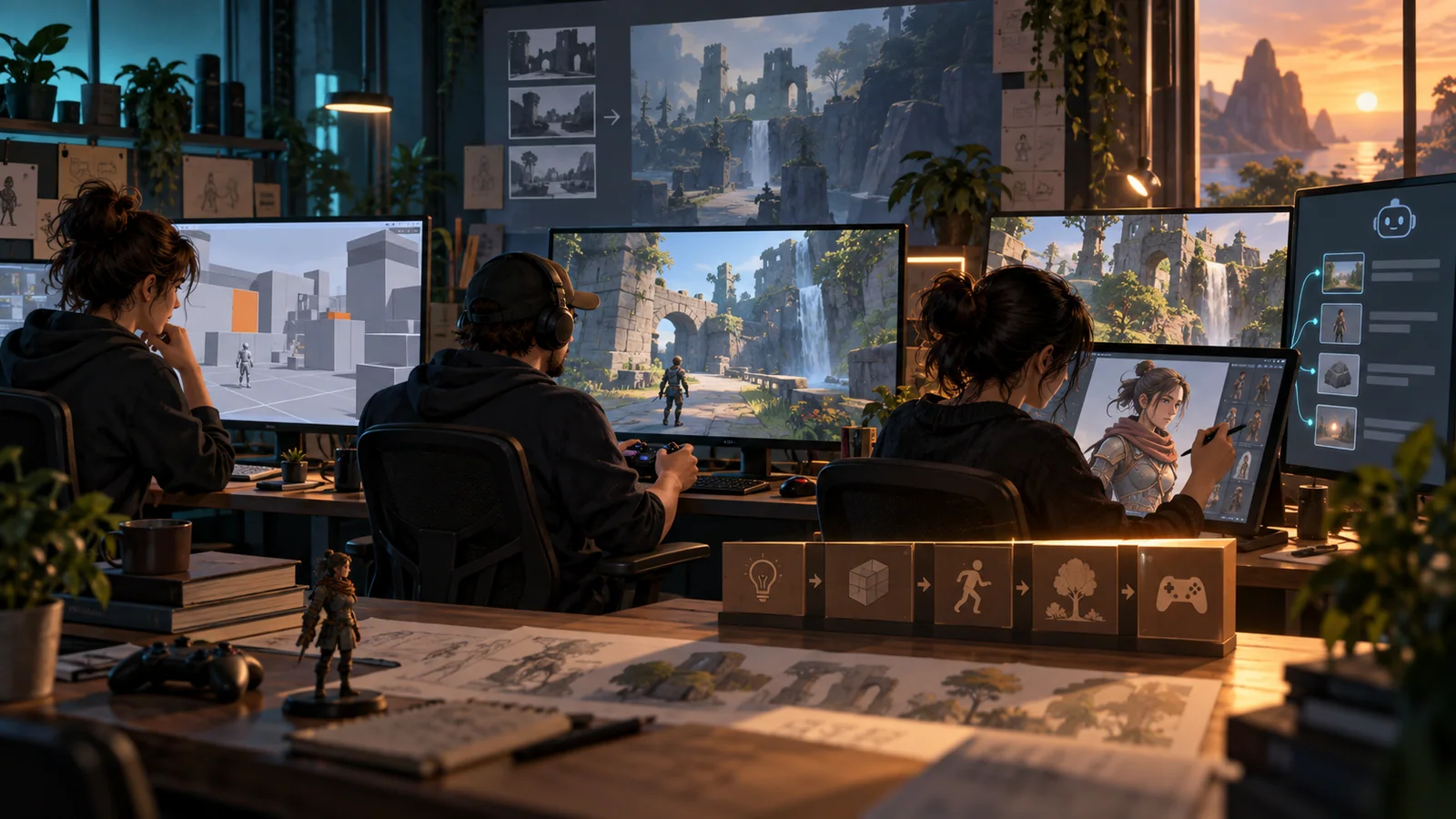
Image: The Game Design
AI makes it possible to create game material before a team has made the decisions that give the material value. That is the central production risk. Code appears. Images appear. A scene runs. None of that proves the right game is being built.
Use these ten gates before committing the next sprint or budget. A “no” does not always mean stop. It means the next task is to resolve that uncertainty instead of generating more content around it.
1. Can you name the player and the promise?
Complete this sentence without using a genre label: “This game is for ___, and in the first five minutes they should feel ___.”
“A roguelike for everyone” is not specific enough. “A short-session tactics game for players who want one meaningful battlefield decision every minute” gives design, UI, pacing, and marketing something concrete to support.
2. Is there one core loop?
Describe the action, feedback, reward, and reason to repeat. If the pitch needs three loops to sound interesting, pick the one that must work first.
AI tools are unusually good at helping a weak concept grow sideways. New systems arrive faster than the team can validate the original one. Keep one loop at the center until players choose to repeat it.
3. Does the next build have an evidence question?
“Make a prototype” is a deliverable, not a learning goal. Choose one observable question:
- Do new players understand the objective without explanation?
- Does aiming, movement, or card selection feel deliberate?
- Do players want another run after the first loss?
- Can the target device maintain the required performance?
- Does the pitch create enough interest to justify a deeper demo?
This question determines what to build and what to fake.
4. Is a human responsible for every acceptance decision?
Name who approves design, code, art, audio, copy, and the final build. “The model produced it” is not approval.
AI can draft alternatives and catch some mistakes. A person still has to decide whether the work fits the game, whether it can ship, and whether it creates a new risk somewhere else.
5. Can you trace the rights for every asset?
Track source, license, tool or model, edits, approval, and intended use. Do this when the asset enters the project, not during launch week.
Temporary material should be labeled as temporary. Official product screenshots, owned development captures, properly licensed stock, commissioned work, and generated assets have different obligations. A clean manifest keeps the team from confusing “available in the folder” with “approved to ship.”
6. Is the first minute readable?
A new player should be able to identify:
- what they control;
- what can be acted on;
- what matters now;
- what success or failure looks like;
- what changed after an action.
If the designer must stand beside every tester and explain those things, the build is testing the explanation rather than the game.
7. Are you testing the exported build?
Run the browser, Windows, mobile, or console artifact that the player will receive. Verify controls, loading, scaling, audio, save behavior, errors, and links in that artifact.
A source-tree smoke test proves the development environment works. It does not prove the release works.
8. Are the playtest questions behavior-first?
Ask where players hesitated, what they tried first, what they repeated, and where they stopped. Then ask what they thought.
Opinions matter, but behavior gives them context. “I liked it” beside an abandoned first session means something different from the same comment after three voluntary runs.
9. Does the package sell the same game the build delivers?
Put the title, thumbnail, first screenshot, one-sentence pitch, and first five minutes next to one another. They should promise the same experience.
This is not cosmetic. A polished thumbnail can attract the wrong player, while vague copy can hide the strongest part of the build. Conversion improves when the promise is specific and the experience pays it off.
10. Is the next decision already defined?
Choose the possible outcomes before the test:
- invest;
- revise;
- re-scope;
- pause;
- stop.
Write the evidence required for each. This prevents a weak result from turning automatically into another sprint because the team is already emotionally invested.
How to use the checklist
Do not treat ten checks as ten weeks of documentation. Run them quickly at the start of a sprint, mark the unresolved gates, and choose the smallest experiment that can close the most important one.
The free AI Game Production Checklist is the compact version to keep beside the build. If you want an independent review of an existing concept or prototype, the current service path begins with a $250 design teardown, followed by a scoped $1,000 prototype sprint when the question needs a build rather than a critique.
FAQ
Do all ten gates need to be perfect before prototyping?
No. A prototype often exists to resolve one of them. You do need to know which gate is unresolved and what evidence would close it.
Can AI review its own output?
It can help find inconsistencies and generate test cases, but acceptance remains a human production decision. Self-review by the same system is not independent validation.
What should a small team track first?
Start with the player promise, core loop, evidence question, asset rights, and exported-build test. Those five prevent the most expensive forms of false progress.
ai-game-development-checklistgame-productiongame-prototypingindie-game-development